Podcast: Play in new window | Download (Duration: 31:59 — 26.8MB)
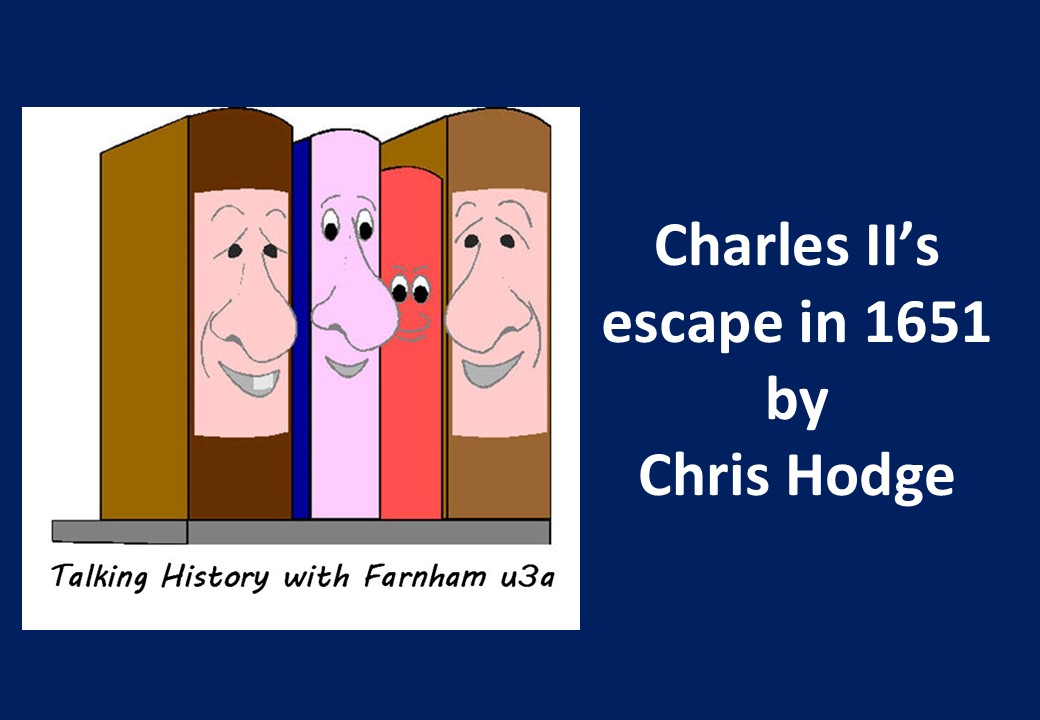
Season 2025 – Talk 11 – Escape of Charles II in 1651
In the ‘Escape of Charles II in 1651 after the Battle of Worcester’ Chris Hodge tells us about the Parliamentarian hunt for Charles II and his problems in getting from England to Europe.
Background:
When the last Tudor monarch Elizabeth I dies in 1603 there are no heirs. James VI of Scotland takes up the throne – making him James VI of Scotland, but also James I of England..
He is a firm believer in his divine right to rule, and so his disdain for Parliament provokes increasingly severe clashes.
In 1625 Charles I ascends to the throne. Like his father he believes in absolute and divine-sanctioned rule. His haughty manner, a refusal to change his mind, and doing anything to have his own way makes him unpopular.
He is ill-suited to the task of handling a troublesome Parliament and maintaining peace between the religious factions. All of this leads to more discontent with the monarchy.
Civil War:
On the 22nd of August, 1642 Charles I raises his standard, a formal declaration of war against Parliament. Royalists against Parliamentarians.
He wants his heir, Charles, to learn about military operations. Aged 12 he accompanies his father to the first major battle of the Civil War at Edgehill.
By 1646 the war is going badly for Charles I. He escapes to Scotland but the Scots hand him over. He is imprisoned. Escapes. Is recaptured. Then executed.
Worcester and aftermath:
On the 3rd of September 1651, Charles’ army meets Oliver Cromwell’s army at Worcester. By late afternoon, it is clear that the Parliamentarians have won.
Now starts the most amazing story of his dodging from place to place to escape capture and certain death. He achieves this by determination, a small group of loyal supporters, good acting, and several pieces of good luck.
Listen to Chris tell the story.
About this podcast:
This is an edited recording of a talk given to the Farnham u3a World History: Ancient, Medieval and Modern Group.
This podcast is also available through Amazon Music, Apple Podcasts, Castbox, Podchaser, Spotify, YouTube and others.

AKM Music licenses Media Magazine for use with this talk.
© The MrT Podcast Studio and Farnham u3a World History: Ancient, Medieval and Modern Group 2018 – 2026